Skip to main content
Contents
Search Book
Search Results:
No results.
Read aloud Readability settings Prev Up Next \(\require{cancel}\let\vecarrow\vec
\renewcommand{\vec}{\mathbf}
\newcommand{\ihat}{\vec{i}}
\newcommand{\jhat}{\vec{j}}
\newcommand{\khat}{\vec{k}}
\DeclareMathOperator{\proj}{proj}
\newcommand{\kg}[1]{#1~\mathrm{kg} }
\newcommand{\lbm}[1]{#1~\mathrm{lbm} }
\newcommand{\slug}[1]{#1~\mathrm{slug}}
\newcommand{\m}[1]{#1~\mathrm{m}}
\newcommand{\km}[1]{#1~\mathrm{km}}
\newcommand{\cm}[1]{#1~\mathrm{cm}}
\newcommand{\mm}[1]{#1~\mathrm{mm}}
\newcommand{\ft}[1]{#1~\mathrm{ft}}
\newcommand{\inch}[1]{#1~\mathrm{in}}
\newcommand{\N}[1]{#1~\mathrm{N} }
\newcommand{\kN}[1]{#1~\mathrm{kN} }
\newcommand{\MN}[1]{#1~\mathrm{MN} }
\newcommand{\lb}[1]{#1~\mathrm{lb} }
\newcommand{\lbf}[1]{#1~\mathrm{lbf} }
\newcommand{\Nm}[1]{#1~\mathrm{N}\!\cdot\!\mathrm{m} }
\newcommand{\kNm}[1]{#1~\mathrm{kN}\!\cdot\!\mathrm{m} }
\newcommand{\ftlb}[1]{#1~\mathrm{ft}\!\cdot\!\mathrm{lb} }
\newcommand{\ftlbf}[1]{#1~\mathrm{ft}\!\cdot\!\mathrm{lbf} }
\newcommand{\inlb}[1]{#1~\mathrm{in}\!\cdot\!\mathrm{lb} }
\newcommand{\lbperft}[1]{#1~\mathrm{lb}/\mathrm{ft} }
\newcommand{\lbperin}[1]{#1~\mathrm{lb}/\mathrm{in} }
\newcommand{\Nperm}[1]{#1~\mathrm{N}/\mathrm{m} }
\newcommand{\kNperm}[1]{#1~\mathrm{kN}/\mathrm{m} }
\newcommand{\kgperkm}[1]{#1~\mathrm{kg}/\mathrm{km} }
\newcommand{\psinch}[1]{#1~\mathrm{lb}/\mathrm{in}^2 }
\newcommand{\pqinch}[1]{#1~\mathrm{lb}/\mathrm{in}^3 }
\newcommand{\psf}[1]{#1~\mathrm{lb}/\mathrm{ft}^2 }
\newcommand{\pqf}[1]{#1~\mathrm{lb}/\mathrm{ft}^3 }
\newcommand{\Nsm}[1]{#1~\mathrm{N}/\mathrm{m}^2 }
\newcommand{\kgsm}[1]{#1~\mathrm{kg}/\mathrm{m}^2 }
\newcommand{\kgqm}[1]{#1~\mathrm{kg}/\mathrm{m}^3 }
\newcommand{\Pa}[1]{#1~\mathrm{Pa} }
\newcommand{\kPa}[1]{#1~\mathrm{kPa} }
\newcommand{\aSI}[1]{#1~\mathrm{m}/\mathrm{s}^2 }
\newcommand{\aUS}[1]{#1~\mathrm{ft}/\mathrm{s}^2 }
\newcommand{\unit}[1]{#1~\mathrm{unit} }
\newcommand{\ang}[1]{#1^\circ }
\newcommand{\second}[1]{#1~\mathrm{s} }
\newcommand{\lt}{<}
\newcommand{\gt}{>}
\newcommand{\amp}{&}
\definecolor{fillinmathshade}{gray}{0.9}
\newcommand{\fillinmath}[1]{\mathchoice{\colorbox{fillinmathshade}{$\displaystyle \phantom{\,#1\,}$}}{\colorbox{fillinmathshade}{$\textstyle \phantom{\,#1\,}$}}{\colorbox{fillinmathshade}{$\scriptstyle \phantom{\,#1\,}$}}{\colorbox{fillinmathshade}{$\scriptscriptstyle\phantom{\,#1\,}$}}}
\)
Section B.2 Right Triangle Trigonometry
A
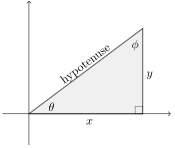
right triangle is a triangle containing a 90° angle.
The side opposite to the right angle is called the
hypotenuse .
The other two angles add to 90° and are called
complementary angles .
The relationship between the sides and angles of a right triangle are given by the three basic trig relations which may be recalled with the mnemonic
SOH-CAH-TOA .
\begin{align*}
\sin\theta \amp= \frac{\textrm{opposite}}{\textrm{hypotenuse}} \amp \cos\theta \amp= \frac{\textrm{adjacent}}{\textrm{hypotenuse}} \amp \tan\theta \amp= \frac{\textrm{opposite}}{\textrm{adjacent}}
\end{align*}
\begin{align*}
\theta \amp = \sin^{-1} \left(\frac{\textrm{opposite}}{\textrm{hypotenuse}}\right) \amp \theta \amp = \cos^{-1} \left(\frac{\textrm{adjacent}}{\textrm{hypotenuse}}\right) \amp \theta \amp = \tan^{-1} \left(\frac{\textrm{opposite}}{\textrm{adjacent}}\right)
\end{align*}
Facts.
The following statements regarding the trig functions and triangles are always true, and remembering them will help you avoid errors.
\(\sin\text{,}\) \(\cos\) and \(\tan\) are functions of an angle and their values are unitless ratios of lengths.
The inverse trig functions are functions of unitless ratios and their results are angles.
The sine of an angle equals the cosine of its complement and vice-versa.
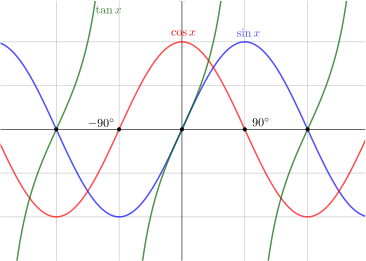
The sine and cosine of any angle is always a unitless number between -1 and 1, inclusive.
The sine, cosine, and tangent of angles between 0 and 90°. are always positive.
The inverse trig functions of positive numbers will always yield angles between 0 and 90°
The legs of a right triangle are always shorter than the hypotenuse.
Only right triangles have a hypotenuse.
Hints.
Here are some useful tips for angle calculations
Take care that your calculator is set in degrees mode for this course.
Always work with angles between 0° and 90° and use positive arguments for the inverse trig functions.
Following this advice will avoid unwanted signs and incorrect directions caused because \(\dfrac{-a}{b} = \dfrac{a}{-b}\text{,}\) and \(\dfrac{a}{b} = \dfrac{-a}{-b}\) and the calculator can’t distinguish between them.